

Top Gasket Tape Suppliers in China You Should Know
2026-10-13
When sourcing gasket tape from China, the sheer number of suppliers can feel overwhelming—yet choosing the right one decides whether your seals hold up under pressure or fail at the worst moment. Most lists recycle the same names, but this one digs into manufacturers that actually deliver consistency, from PTFE to graphite and beyond. Among them, Kaxite stands out for its no-nonsense approach to quality control and responsive custom work. Whether you're an engineer tired of leaky joints or a procurement manager hunting for reliable inventory, the suppliers below aren't just names—they're the ones worth a closer look.
Where China's Gasket Tape Makers Actually Compete on Quality
For years, gasket tape from China was treated as a commodity purchase, judged mainly by price per roll. That is changing fast. A cluster of manufacturers in the Yangtze River Delta and around Foshan now compete on measurable performance: foam density consistency, compression set values, and adhesive peel strength after heat aging. Buyers who still assume all Chinese tape is the same often end up reworking joints or replacing seals within a season.
The real battleground is tolerance control. Top-tier factories run laser thickness gauges on every production line and reject rolls that drift more than a few hundredths of a millimeter from spec. That matters in HVAC flange assemblies and automotive weather seals, where uneven tape can cause leaks or uneven clamping pressure. Some makers now publish batch-level test data instead of vague datasheets, a practice that would have been rare ten years ago.
Adhesive formulation is another differentiator. Rather than using a single off-the-shelf acrylic, leading Chinese producers compound their own adhesives for specific substrates such as powder-coated metal, ABS, or EPDM rubber. This lets them tune initial tack, cure time, and temperature resistance to the application. It is not glamorous work, but it is exactly the kind of quiet engineering that separates a gasket tape that holds for a decade from one that fails after the first hot summer.
PTFE, Silicone, or Graphite: Matching the Tape to the Job
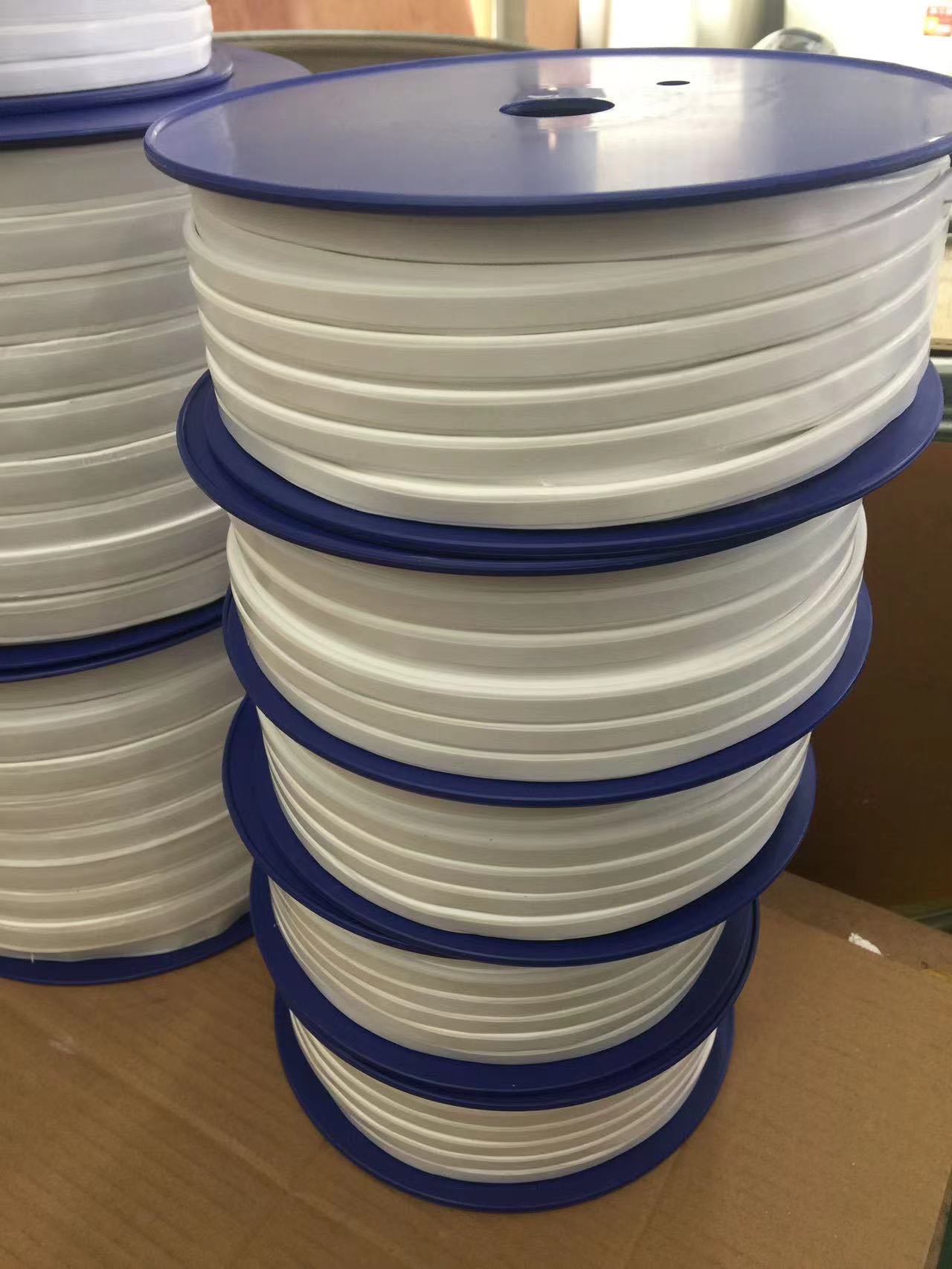
Thread seal tapes are not interchangeable, and picking the wrong one leads to leaks or seized fittings. PTFE tape, the most common option, handles water, air, and many chemicals but struggles with high heat and aggressive solvents. Silicone tape has no adhesive and fuses to itself, making it ideal for insulating electrical connections or temporary repairs on hoses and cables where flexibility matters. Graphite tape, on the other hand, tolerates extreme temperatures and high pressure, which is why you see it on steam lines, boiler fittings, and valve stems in industrial settings.
A common mistake is using standard PTFE on gas lines. Natural gas and propane require a denser, yellow-colored tape rated for fuel, or better yet a liquid sealant, because standard white tape shreds and the fragments can clog orifices. For potable water, look for tape labeled NSF/ANSI 61. For hydraulic systems, skip tape entirely and use a paste or anaerobic sealant. The job dictates the material, not habit.
Check the temperature and pressure ratings before wrapping. PTFE tape usually breaks down above 260°C, while graphite tape can handle over 400°C. Silicone tape, though not a thread sealant by design, often serves as a temporary patch because it stretches and conforms to odd shapes. In any case, wrap in the direction of the threads, use only two or three layers, and never over-tighten. A little know-how about the material properties prevents most callbacks.
How to Spot a Supplier That Cuts Corners on Thickness
Start by checking the weight of the delivered material against the theoretical weight for the ordered thickness. Suppliers that shave off a fraction of a millimeter often forget that density doesn't lie. A quick calculation with the given dimensions and metal or polymer density will tell you if the coils or sheets are underweight before you even unroll them. This catches many quiet downgrades early.
Next, ask for three cut samples from different production batches, not the hand-picked reference piece. Measure each with a calibrated micrometer at the edges, center, and at least two midpoints—corners and edges are favorite hiding spots for thinning. Then compare the printed mill markings on the actual material with the spec sheet. If the numbers don't match or the thickness drifts below tolerance on later samples, you're dealing with a supplier that hopes you'll never check.
Finally, write a small penalty clause into the purchase order for thickness variation beyond agreed tolerances. Suppliers that cut corners on thickness hate that clause because it converts their hidden savings into chargebacks. It's remarkable how quickly measurements improve when the risk shifts back to them.
Why Minimum Order Quantities Vary So Much Across Factories
MOQs are rarely arbitrary. A factory running fully automated lines for standard components can absorb short runs without losing money, so their minimums drop. The moment you ask for a non-stock color, a modified thread pattern, or a custom logo, the calculus changes. Setup time, wasted material during calibration, and the risk of producing a batch nobody else will buy all push the number upward. Smaller workshops often quote higher MOQs not because they are inflexible, but because they lack the volume to spread those fixed costs across thousands of units.
Geography and supply chains play an equally direct role. A factory sitting next to raw material suppliers can order smaller quantities of inputs on short notice, which keeps their own minimums low. Another factory importing the same raw material from two time zones away needs a larger buffer and a larger production run to make the freight worthwhile. Labor laws, energy costs, and even local tax structures quietly reshape the break-even point. Two factories making the same product can end up with MOQs separated by a factor of ten simply because one pays triple for electricity during peak hours.
Then there is the question of what "minimum" actually protects. Some MOQs reflect genuine production constraints. Others are filters to avoid low-value clients. A factory with a strong order book may raise MOQs deliberately to keep capacity free for repeat customers, while a new factory hungry for references will accept a smaller order at a slimmer margin. Understanding which type of factory you are talking to matters more than the number itself.
Custom Widths, Adhesives, and Backings: What's Feasible
Custom widths rarely start from a blank slate. Most converters can slit master rolls down to a surprisingly narrow strip, but there's a floor—usually around 3 to 6 mm depending on the backing stiffness and adhesive thickness. Below that, edge quality suffers and the adhesive can ooze during cutting. On the wide end, you're limited by the original master roll width, so if you need something beyond 60 inches, expect a specialty source and a longer lead time.
Adhesive customization is where things get genuinely flexible, but it's not infinite. Standard acrylics, rubbers, and silicones cover a lot of ground. If you need a specific tack level, temperature range, or removability, many coaters will tweak a formulation—once you hit a minimum order that can be a few hundred square meters. The real constraint is cure time and stability: a one-off custom adhesive might not have the same shelf life or batch-to-batch consistency as an off-the-shelf product.
Backings follow a similar logic. Films like PET and polyimide can be sourced in different thicknesses and finishes, but changing the base material entirely—say from a film to a nonwoven—often means a separate coating run. Laminating a second layer, such as a foil or a release liner, is usually easier than reformulating the adhesive. If the combination you want already exists in a supplier's catalog, even in a different width, that's often the fastest path to a workable custom part.
Questions to Ask Before You Finalize a Supplier Shortlist
Before locking in your final supplier shortlist, step back and poke at the assumptions you've been carrying through the sourcing process. Have you genuinely verified that each remaining vendor can scale with your demand spikes, or are you trusting a sales rep's slide deck? Dig into their recent client churn, not just case studies. Ask what happened with their last three lost accounts—the answers often reveal more than polished references.
A second layer worth probing is operational transparency. If a supplier can't walk you through their contingency plans for raw material delays, IT outages, or key staff turnover, that silence is a data point. Request a dry run of their escalation process: who gets the call at 2 a.m., and what's the actual recovery timeline they've hit in the past twelve months? Compare that against what your own customers would tolerate.
Finally, force yourself to question the shortlist itself. Are all these vendors truly distinct options, or are three of them mirror images because they came from the same trade show or referral chain? Before you finalize, ask each one: 'If you were us, which competitor on this list would you actually pick, and why?' Their hesitation—or honesty—can sharpen your own judgment far better than another scorecard.
FAQ
It often comes down to their ability to customize material blends and hold tight tolerances on thickness and density. The best ones will send you samples without hesitation and provide full data sheets covering temperature limits, pressure ratings, and chemical compatibility. If a supplier avoids technical questions or only pushes price, that's usually a red flag.
Some can, but not all. Look for ISO 9001 certification and check whether their products meet ASTM, DIN, or FDA requirements. Ask for recent third-party test reports or send samples to an independent lab yourself. Suppliers with very low prices often cut corners on raw material purity or product density.
Stop comparing only unit prices. Ask about density, compression, recovery, and the exact temperature and pressure range. Always request samples and run a real installation test. Check packaging for moisture protection, since some filler materials absorb humidity. Also confirm minimum order quantities and lead times before you commit.
You will usually find expanded PTFE tape, graphite tape, ceramic fiber tape, non-asbestos tape, and mica tape. Many suppliers also offer self-adhesive versions for easier installation. A good supplier will recommend different density and width options based on the flange surface, media, and operating conditions.
Most manufacturers accept custom width, thickness, and length as long as you meet their minimum order quantity. Private labeling and custom packaging are also common, but they usually carry extra costs or require a larger volume. Provide drawings or detailed specifications in your first inquiry to avoid back-and-forth delays.
For standard products, many suppliers can ship within one to two weeks. Custom items often take three to five weeks, especially if special backing or non-standard thickness is involved. If the project is urgent, ask about ready stock or express channels. Remember to include ocean freight time unless you plan to use air shipping.
Some leading manufacturers do provide application guidance, such as recommending the right thickness and compression for specific flange types, media, and bolt torque. They may even send engineers to help solve on-site leakage problems. That kind of support can be extremely valuable in high-temperature, high-pressure, or corrosive environments.
Conclusion
China's best gasket tape suppliers rarely advertise themselves as generalists. They compete on measurable consistency—tensile strength, compressibility, and thickness tolerance across every roll. If your application runs hot or handles aggressive chemicals, you'll quickly see why PTFE, silicone, and graphite tapes serve entirely different jobs: PTFE for chemical resistance and clean release, silicone for high-temperature cushioning, graphite for steam and thermal cycling. The suppliers worth knowing will ask about your operating temperature, pressure, and flange condition before quoting, because a tape that performs perfectly in one setting can fail badly in another. They also tend to reject orders that would require them to skimp on thickness—one of the most common shortcuts is supplying tape 10–15% thinner than specified while keeping the same roll length and price.
Minimum order quantities in this niche are not random. A factory running continuous coating and slitting lines can offer lower MOQs for standard widths, while smaller workshops often set higher MOQs because every changeover eats into margin. Custom work—unusual widths, acrylic or silicone adhesives, foil or PTFE backings—is feasible at many Chinese suppliers, but only if you're willing to accept longer lead times and sometimes a slightly higher per-unit cost for the first few batches. Before finalizing any shortlist, ask for a full data sheet with thickness measured at multiple points, a sample roll from current production (not a "golden sample"), and a clear answer on how they handle batch-to-batch variation. A supplier that hesitates on these questions is usually hiding something more expensive than a missing discount.
Contact Us
Contact Person: Kaxite
Email: [email protected]
Tel/WhatsApp: 0086-574-87527771
Website: https://www.seal-china.com
