IEC Standard Air Circuit Breaker Safety and Performance Guide
2026-10-09
When an air circuit breaker fails, the downstream consequences rarely stay downstream. IEC 60947-2 sets the bar for safety and performance, but meeting it in real installations demands more than a certificate on paper. This guide walks through what the standard actually requires, where designs commonly fall short, and how MOLDVOLT builds ACBs that hold their ratings under stress—not just on the test bench.
Arc Quenching Mechanisms That Keep Air Circuit Breakers Safe
Air circuit breakers rely on a combination of arc elongation, cooling, and splitting to interrupt fault currents safely. When the contacts separate under load, the resulting arc is driven upward into an arc chute by both thermal buoyancy and magnetic forces. The chute's stacked steel plates divide the arc into a series of shorter arcs, each requiring a higher voltage to sustain, which rapidly raises the overall arc resistance and forces current to zero.
Within the arc chute, the plates also absorb heat from the plasma, lowering its temperature and deionizing the surrounding air. This cooling effect is critical because hot, ionized air would otherwise re-strike and re-establish conduction. Some designs add a puffer or blowout coil to accelerate the arc into the chute, shortening the interruption time and reducing contact wear.
At current zero, the dielectric strength of the air gap must recover faster than the voltage across the contacts rises. The splitter plates create multiple cathode-anode voltage drops, and the cooled gas helps sweep away ionized particles. Together these mechanisms ensure that a restrike is avoided and the circuit is left in a safe, open state.
How IEC 60947-2 Defines Breaker Performance Benchmarks
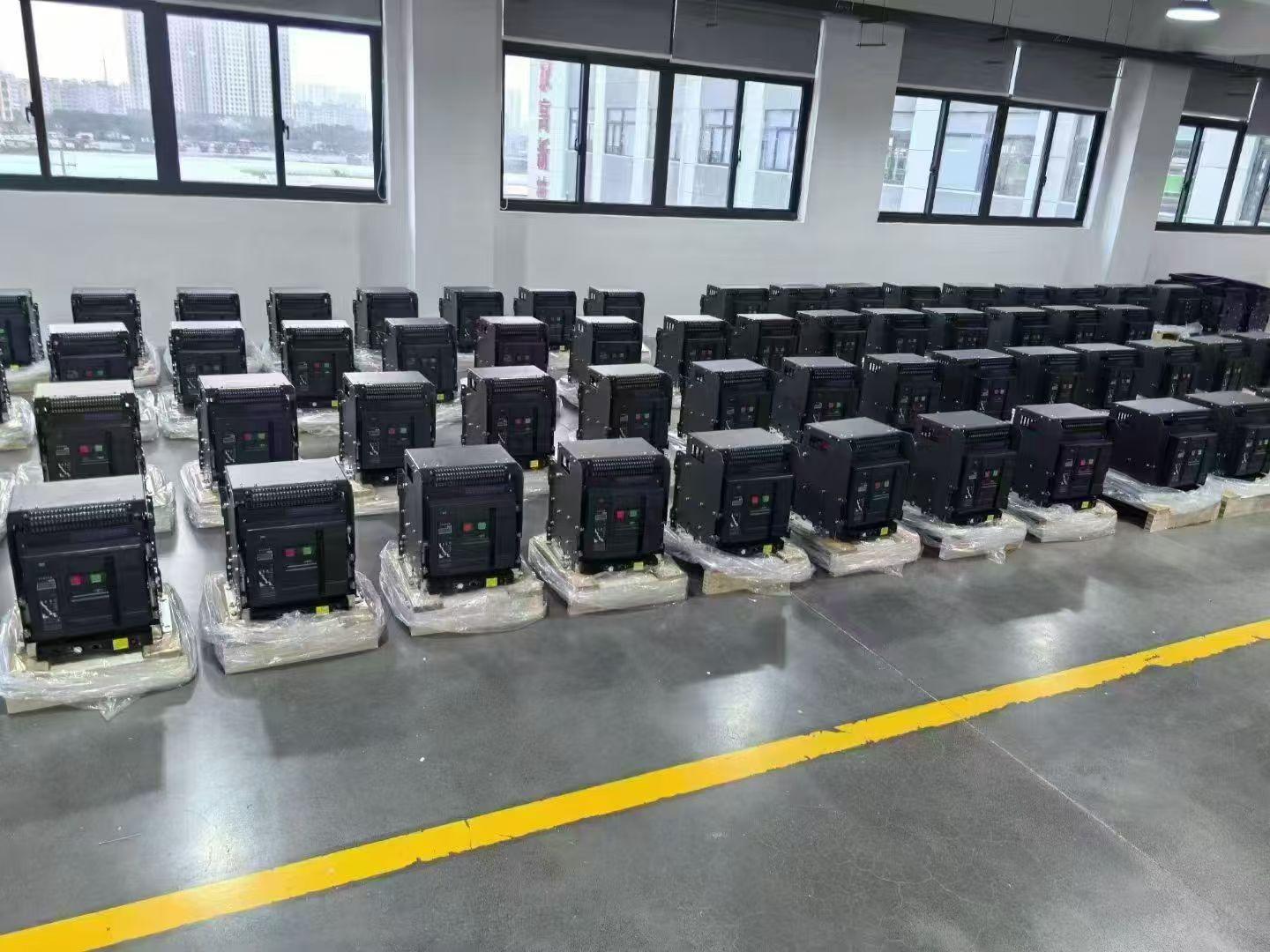
IEC 60947-2 doesn't just list pass/fail thresholds; it anchors breaker performance to a set of defined service conditions and test sequences that mimic real-world stress. The standard separates short-circuit capability into two distinct benchmarks: ultimate breaking capacity (Icu) and service breaking capacity (Ics). Icu represents the maximum fault current a breaker can interrupt once, after which the unit may be damaged but must remain safe. Ics, by contrast, requires the breaker to interrupt the same level of current multiple times and still carry its rated current afterwards. This distinction forces manufacturers to disclose whether a product is built for rare catastrophic events or for repeated interruptions in demanding installations.
Beyond fault interruption, IEC 60947-2 uses endurance and temperature-rise criteria to define everyday reliability. Mechanical and electrical endurance tests simulate years of switching under load, with specified numbers of operations tied to the breaker's frame size and utilization category. Temperature rise limits under full rated current ensure that terminals and internal contacts stay within safe thermal boundaries, preventing insulation degradation over time. These benchmarks are not arbitrary; they're derived from consensus among testing laboratories, utilities, and manufacturers, reflecting field failures and the need for predictable maintenance intervals.
The standard also maps performance to specific application categories, such as Category A breakers without intentional time delay and Category B breakers with short-time withstand ratings. A Category B device must prove its ability to withstand a defined short-time current (Icw) for a set duration without tripping, enabling selective coordination in cascaded networks. This creates a tiered benchmark system where selecting a breaker involves more than matching its amp rating to the load; it requires verifying that the breaker's Icu, Ics, Icw, and endurance figures align with the upstream protection strategy and expected fault levels. Testing according to IEC 60947-2 thus becomes a language that both specifiers and suppliers can use to compare real capability, not just catalog claims.
Safety Interlocks That Guard Against Operational Mishaps
Safety interlocks do their real work before an operator ever touches a control. A well-designed interlock forces the machine through a safe sequence: the power drops out, a brake engages, stored pressure bleeds away, and only then does the access panel release. When that order is built into the hardware, you don't have to rely on someone remembering the right step under time pressure.
Take a horizontal baler as an example. The interlock chain might tie the loading gate to the ram position sensor and a zero-speed detector on the flywheel. If any of those signals says the ram could still move, the gate stays locked. That kind of chain stops exactly the sort of accident where a worker reaches in to clear a jam and the machine cycles unexpectedly. On a packaging line, a door switch with a trapped key can prevent a filler from restarting while someone's hand is still inside the guarded area.
Bypassing is the constant enemy. A worker who has to wait through a slow reset will eventually figure out how to tape a magnet over a reed switch. Better interlocks account for that reality. They use tamper-evident seals, coded RFID safety switches that can't be fooled with a jumper, and control logic that logs every open-and-close event. The goal isn't just to guard the machine; it's to make running the machine with the guard defeated more trouble than doing the job properly.
Choosing Air Circuit Breakers for Demanding Industrial Loads
In heavy industrial plants, load profiles rarely behave like simple resistive curves. Large motors, welding machines, and arc furnaces introduce steep inrush currents, harmonics, and short-time overloads that can trip a standard breaker or accelerate contact wear. Selecting an air circuit breaker (ACB) therefore starts with a realistic load study: capture the peak starting currents, duty cycles, and any regeneration or backfeed conditions. Choose a breaker whose trip unit can be programmed to ride through normal inrush while still clearing genuine faults quickly—thermal-magnetic units often fall short here, so an electronic trip unit with adjustable long-time, short-time, and instantaneous functions becomes essential.
Short-circuit withstand and coordination demand equal attention. In many industrial networks, available fault currents exceed 50 kA or more, and a breaker with insufficient breaking capacity will fail catastrophically when it matters most. Check both Icu (ultimate breaking capacity) and Ics (service breaking capacity) against the calculated prospective fault current at the point of installation, leaving a safety margin for grid changes. Beyond capacity, selective coordination keeps a single motor fault from blacking out an entire production line. Time-based discrimination works, but zone-selective interlocking or energy-based coordination gives faster upstream response without sacrificing selectivity—especially useful when multiple ACBs feed critical process buses.
Physical environment and maintainability often decide whether a good ACB becomes a reliable one. High ambient temperature, conductive dust, humidity, or vibration can reduce current-carrying ability and degrade mechanical parts. Derating tables and enclosure ratings should be reviewed early, not as an afterthought. For loads that cannot tolerate unplanned downtime, choose ACBs with modular accessories, visible contact wear indicators, and communication interfaces that report temperature, operation counts, and trip history. This turns the breaker into a condition-monitoring point, allowing maintenance teams to replace contacts or adjust settings based on actual wear instead of a fixed calendar.
Extending Service Life Through Targeted Maintenance Routines
Equipment rarely fails all at once; most breakdowns begin as small, measurable deviations from normal operation. Targeted maintenance flips the script by treating each machine as a collection of failure modes rather than a single block on a calendar. Instead of blanket overhauls, technicians use vibration readings, thermography, and oil analysis to catch the early signatures of wear in bearings, seals, or drive belts. This granular view means a pump in a dusty corner might need bearing lubrication every 200 hours, while an identical unit in a cleanroom runs safely to 500. The routine becomes a living schedule, revised each cycle based on what the data actually says—not what a generic manual assumes.
The real payoff shows up in hard numbers over a two- or three-year span. A plant that shifts from fixed-interval servicing to condition-based targeting often sees unplanned downtime drop by a third or more, simply because failures are intercepted before they cascade. Consider a conveyor motor: a subtle rise in shaft misalignment caught through laser alignment checks might add 18 months to its service life, avoiding a $12,000 replacement and a half-day line stoppage. These routines also reduce wasted effort. Technicians stop replacing parts that still have useful life left and focus attention where the data points—a sharp contrast to the old “replace it because the schedule says so” mentality that burns both labor hours and spare parts budgets.
Longevity isn’t just about fixing what’s broken; it’s about slowing the rate at which things degrade. Targeted routines often include small, high-impact actions like keeping hydraulic fluid free of moisture, tightening electrical connections to spec, or monitoring belt tension under load. These steps seem minor until you trace the chain: cleaner fluid means less valve erosion, proper torque means fewer hot spots, correct tension means reduced bearing side-load. Over a decade, the cumulative effect can stretch asset life by 20–40% compared to untargeted upkeep. And because maintenance history feeds back into the plan, the routine keeps refining itself—each inspection round makes the next one smarter, turning a simple checklist into a genuine life-extension strategy.
Interpreting Short-Circuit Ratings for Smarter Protection
Short-circuit ratings often get reduced to a single number on a nameplate, but that number only tells part of the story. A breaker labeled 65 kAIC, for instance, describes the maximum fault current it can interrupt without destroying itself—not the current it will actually see at a specific point in your system. Real protection decisions depend on calculating available fault current at the equipment terminals, accounting for conductor impedance, transformer size, and motor contribution. Ignoring those variables leads either to over-specifying expensive gear or, far worse, installing devices that can't clear a real fault.
Smarter protection means matching the interrupting rating to the calculated fault level with a margin that accounts for future system growth. Too often, designers treat the rating as a standalone pass/fail criterion. Instead, think of it as one part of a coordination study. A downstream device with a lower rating can still be safe if an upstream current-limiting fuse or breaker reduces the let-through energy below the downstream equipment's withstand rating. That kind of layered interpretation—rather than simply comparing catalog numbers—prevents nuisance trips and protects against arc-flash hazards.
Finally, remember that short-circuit ratings assume certain conditions: bolted faults, specified voltage, and correct installation. Loose connections, aging insulation, or modified bus bracing can all degrade performance. For smarter protection, revisit the ratings whenever the system changes, not just during initial design. A motor added on a branch circuit, a larger transformer, or even a new feeder length can shift fault current enough to render a previously adequate rating marginal. Treat the rating as a living parameter that demands periodic verification, and your protection scheme will stay robust long after the first commissioning report is filed.
FAQ
Icu is established through type tests under IEC 60947-2, where the breaker must interrupt a specified maximum fault current at rated operational voltage and a given power factor. After the test, the unit still has to withstand a dielectric check and show no danger to the operator.
The insulation coordination follows IEC 60664-1, taking into account overvoltage category and pollution degree. Clearance prevents direct arc-over between live parts, while creepage protects against tracking across insulating surfaces in dusty or humid environments.
Icw shows how long the breaker can carry a fault current without opening, which matters when you need selective coordination with downstream devices. A higher Icw lets upstream and downstream breakers discriminate properly, limiting an outage to the smallest possible section.
Secondary injection testing is the most reliable method. You inject calibrated current signals into the trip unit while the breaker is de-energized and compare the trip times against the original settings. This catches drift in sensors, wiring, or the trip unit itself.
Ambient temperature above the reference value affects the thermal trip element and the current-carrying capacity of internal conductors. You need to reduce the continuous current rating or add forced ventilation so that hot spots do not exceed the breaker's certified temperature rise limits.
Arc chute inspection is often skipped because it requires partial disassembly. Carbon deposits and eroded arc splitter plates can increase arc duration and reduce interrupting performance, so they should be checked and cleaned or replaced according to the manufacturer's service schedule.
Conclusion
Air circuit breakers built around IEC 60947-2 don't just interrupt current—they manage the violence of an arc through chutes, splitters, and cooling plates that stretch and quench the plasma before it can cause damage. That mechanical discipline is what the standard measures: making and breaking capacities, temperature rise, dielectric withstand, and endurance cycles all get pushed well past nominal ratings. Safety interlocks add another layer, preventing a closed breaker from being racked out or a misaligned contact from closing under load, so operational mistakes don't turn into arc flashes. The guide frames these features not as optional upgrades but as the baseline for any installation where a failed breaker would put people and downstream equipment at risk.
Selection for heavy industrial loads means looking beyond frame size and ampere rating. Repeated motor starts, harmonics, and high available fault currents change how a breaker behaves, so short-circuit ratings need careful interpretation—peak withstand, Icu versus Ics, and time-current curves all matter when coordination is the goal. A breaker rated for the job but poorly maintained can still fail, which is why targeted routines like contact wear inspection, mechanism lubrication, and trip unit testing are treated as part of the performance envelope rather than afterthoughts. The guide ties these threads together: a well-chosen, correctly applied, and regularly serviced air circuit breaker under IEC 60947-2 delivers protection that stays predictable over years of demanding operation.
Contact Us
Contact Person: Hellen
Email: [email protected]
Tel/WhatsApp: 86-13634205622
Website: https://www.voltcabinet.com